The “Find It” game is a sniffing activity in which dogs use their sense of smell to search for hidden rewards. Here, we’ll start with a simple find-the-treat game.
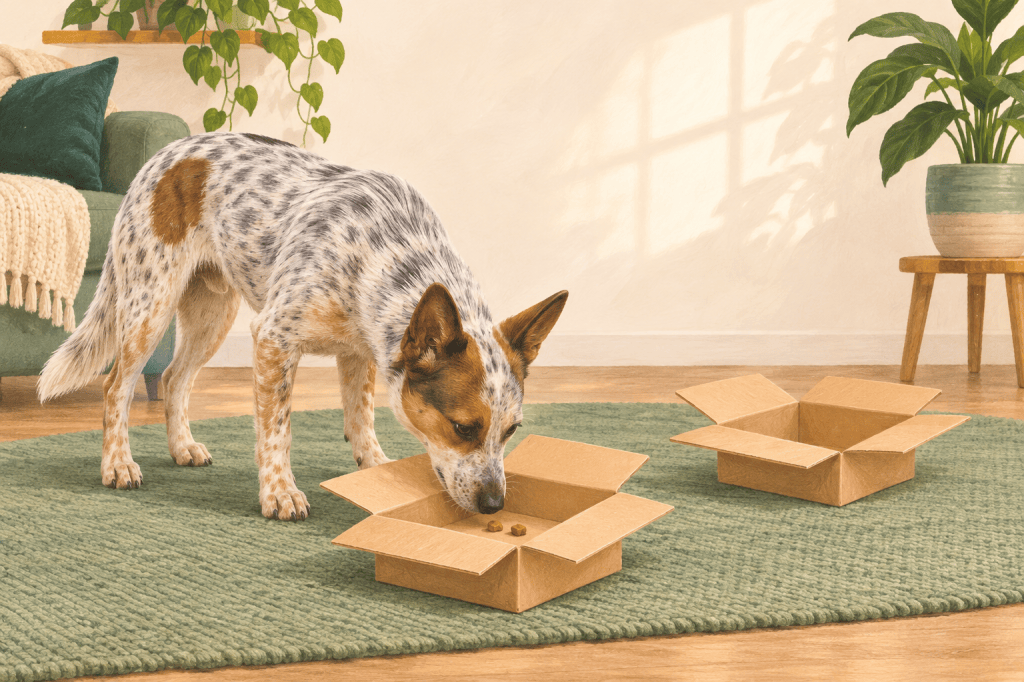
How to Play “Find It”
Use treats your dog enjoys: Tiny pea-sized pieces of high value treats with strong scent, such as cooked chicken, cheese or hot dogs.
Optional: Paper lunch bags or small cardboard boxes, to use as treat holders. If your dog starts to chew on the treat holders, stop using them.
Setting up: Keep other pets separately occupied. You may want to use a room with a door that closes so you can set up without your dog immediately helping themselves to the treats.
Warm-Up (Introductory Finds)
• Start easy. One or two ‘hides’ is plenty at first.
• Place visible treats in easy locations such as on the floor to help the dog catch the scent and build value for using their nose to search. You can use small open boxes or open paper bags as treat holders.
• Reinforce with praise when the dog finds the treats and, of course, let them have the treats.
• Keep sessions short. Put out another one or two hides while your dog isn’t looking. Do this for 2-3 rounds, if your dog seems interested, then give it a rest. You want to stop while the dog is still finding the game fun and interesting.
• Play the easy version for as long as you need to. Don’t rush to make it more challenging.
As your dog figures out the game, add challenges slowly
• Begin placing treats—or open containers holding treats—farther into the room to encourage exploration.
• Optional: add a cue such as “Find It”
• Adjust hide locations around obstacles (chair legs, table edges).
• Add some empty bags as distractors.
• Be mindful of stress or frustration signals. Dogs may look to the handler for help if they can’t solve the puzzles. Don’t make it too challenging. The objective is fun!
Secrets to success:
- Only play “Find It” with one dog at a time.
- Do not mix with other training exercises; no sitting, staying, or heeling. Give your dog permission to just focus on sniffing.
- Do not use aversive techniques; leave “No” at the door.
- Avoid coaching or directing your dog unless they’re getting frustrated or looking to you for help. Encourage them by praising them or moving closer to the treat.
- Watch your dog and let their interest guide the session.
- Be patient! Dogs may need multiple sessions before they are secure enough to play or want treats.
- Playing outside is much more challenging than inside, so be prepared to make the game a little easier outside.
- If you’re playing outside or your dog isn’t fully housebroken, potty the dog before and after the session.
- Dogs can play with the handler holding the leash. Keep the leash loose and follow your dog rather than steering them.
Sniffing is good for dogs!
Versatile, Low-Impact Activity
“Find It” is a low-impact enrichment activity that can be adapted to each dog’s physical ability (e.g., low hides, short sessions, minimal jumping). It can be performed indoors without strenuous physical effort, making it especially useful during winter or inclement weather when walks may be shortened.
Mental Stimulation & Emotional Well-Being
Sensory enrichment, including olfactory enrichment, can alter dog behavior, including stress-associated behaviors and may help alleviate boredom.
A controlled study found that nosework dogs, compared to dogs doing heelwork, became quicker to approach a bowl in an unfamiliar location where they didn’t know whether food would be available. This was interpreted as a more optimistic response. *
Confidence Building
Because scent enrichment encourages exploration and engagement, it may help build your dog’s confidence.
* Duranton C, A. Horowitz, Let me sniff! Nosework induces positive judgment bias in pet dogs, Applied Animal Behaviour Science, Volume 211, 2019, Pages 61-66, ISSN 0168-1591, https://doi.org/10.1016/j.applanim.2018.12.009.


Leave a Reply